


Hiram Medina: Keeping trading simple, disciplined, and transparent

Every trader has a story, but for Hiram Medina, his journey began with a simple goal: finding a career that gave him the freedom to spend time with his family. That search eventually led him to the financial markets.
Today, the Latin American trader and latest Exness Team Pro member primarily trades the Nasdaq 100 and is committed to making trading education more transparent.
In this interview, Hiram shares the experiences that shaped his approach to trading, and why he believes discipline, simplicity, and risk management are the foundations of long-term growth.
Before becoming a trader, you studied electronic engineering and ran several businesses. What led you to pursue trading instead?
I studied electronic engineering because it was what my father wanted for me. After graduating, I realized it wasn't the life I wanted, so I started several businesses instead. They were successful, but once my son was born, I realized I had very little time to spend with my family.
I wanted more control over my time while still being able to provide for them. That led me to explore different opportunities, and eventually, my brother introduced me to trading.
At first, I was attracted by the financial opportunities it offered, but I quickly realized it wasn't something you could master overnight. I had to study, practice, and start from the basics. As I learned, I also began teaching trading fundamentals to beginners, which helped me improve even more.
I've always believed that one of the best ways to truly understand something is to teach it. Looking back, that's how my journey as both a trader and educator really began.
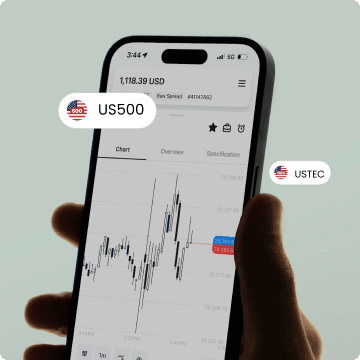
Access top global indices
Trade leading stock indices across the US, UK, China, Germany, and Japan, with ultra-fast execution and low and stable spreads.*
Spreads may fluctuate and widen due to factors including market volatility, news releases, economic events, when markets open or close, and the type of instruments being traded.
You often say that trading isn't gambling. What separates a professional trader from someone who's simply taking a chance?
The biggest difference is preparation. Like any profession, trading takes years of practice, continuous learning, and the discipline to improve over time.
I often compare it to football. Almost everyone knows how to kick a ball, but very few become professional players. The ones who reach that level spend years practicing and mastering their craft. Trading is no different.
Another key difference is focus. Rather than trying to trade everything, I've chosen to specialize in the Nasdaq 100. I know how it moves, when opportunities tend to appear, and the setups I'm looking for. The more you narrow your focus, the deeper your understanding becomes.
Risk management is just as important. Every trade is based on probabilities, not certainty. A professional accepts that losses are part of the process and manages risk accordingly, instead of hoping every trade will be profitable. That's what separates trading from gambling.
Your background is in electronic engineering. How has that shaped the way you approach trading?
Engineering taught me to solve problems rather than avoid them. At university, no one was going to hand me the answers. I had to keep working through difficult problems until I found the solution. That mindset has stayed with me throughout my trading career.
When I first started trading, I made plenty of mistakes. Instead of blaming the market, the broker, or my strategy, I learned to ask myself what I needed to do differently. Every mistake became something to analyze.
I believe that's one of the biggest differences between traders who grow and those who don't. If you want different results, you have to be willing to change something. The market doesn't need to change. You do.
Your trading strategy is built around simplicity. How did you arrive at that approach?
When I first started trading, I was like many traders. I wanted to trade everything, and I was always looking for the next strategy that might work better.
During the pandemic, I simplified my approach. Instead of jumping between different markets and strategies, I focused on one instrument, the Nasdaq 100, and dedicated myself to understanding how it behaves.
Today, my strategy is based on market structure, support and resistance, and a small number of clearly defined setups around the New York market open. I don't believe you need a complicated system to become a consistent trader.
If I had to describe my approach, it would simply be: focus on one thing and work to master it.
Your approach to risk management has evolved significantly over the years. What changed?
In the beginning, I made the same mistakes many traders make. I overleveraged, risked too much on individual trades, and believed that a bigger position would lead to bigger profits. Instead, it led to bigger losses.
Over time, I realized that protecting my capital had to come first. Today, I risk no more than 1% of my account on a single trade, and I usually take just one trade a day. If I lose, I accept it and move on. There's no need to keep trading just to recover the loss.
That discipline changed my trading. I know not every trade will be profitable. What matters is following my plan and managing risk every time.
A loss that follows your plan isn't a bad trade. It's simply one possible outcome.
Many traders only share their profitable trades. Why do you believe it's important to share your losses as well?
I think it's important to be honest about the reality of trading. No trader profits on every trade, and pretending otherwise creates unrealistic expectations for people who are still learning. I want people to understand that a losing trade doesn't make you a bad trader.
That's why I share my trading results with my community. When a trade doesn't work out, we review it together. We look at whether I followed my plan, what happened, and what we can learn from it.
You spend a lot of time educating new traders. What's the biggest mistake you see beginners make?
I think many beginners expect trading to deliver results much faster than it realistically can. They move from one strategy to another, searching for the perfect setup, instead of taking the time to master one approach.
My advice is to choose one market, one strategy, and give yourself time to learn it properly.
Consistency comes from mastering one approach, not constantly searching for another.
Trading is a profession, and like any profession, developing trading skills takes time.
What made Exness the right partner for you, and what are you looking forward to as an Exness Team Pro member?
What stood out to me about Exness is that the products genuinely support the way I teach.
One example is the Standard Cent account. It's a great tool for beginners because it lets them experience real market conditions while managing much smaller amounts of capital. It helps traders focus on developing good habits before increasing their risk.
I also value the trading conditions. Fast withdrawals, competitive spreads, and reliable execution make a real difference when you're trading consistently.
As an Exness Team Pro member, I'm excited to reach more Spanish-speaking traders and continue creating educational content that helps people develop their skills.
If you could leave traders with one piece of advice, what would it be?
Keep it simple.
Many traders think they need to learn everything or trade every market, but that's rarely the path to consistency. Choose one market, one strategy, and give yourself the time to master it.
At the same time, don't overlook risk management or your mindset. Accept that losses are part of trading, follow your plan, and keep working on yourself.
A long-term approach to trading
Hiram's approach to trading isn't built around finding the perfect strategy. It's built around preparation, discipline, and a commitment to continuous learning.
As he joins Exness Team Pro, his focus remains the same: helping Spanish-speaking traders develop practical skills, understand the importance of risk management, and see trading as a profession that takes time to master.
For traders across Latin America and beyond, Hiram's journey reminds them that long-term development doesn't come from chasing every opportunity. It comes from following a clear process, staying accountable, and continuous learning.
This article does not constitute investment advice. Past performance is not indicative of future results. The information, data, prices, and market conditions presented in this article are accurate as of the publication date and may change over time. Your capital is at risk. Please trade responsibly.